Author: ADMIN

  • Driving Lessons in Oxford with Experienced Instructors

    Driving Lessons in Oxford with Experienced Instructors

    Tips To Find Affordable Driving Lessons In Oxford

    It can be tricky to find a driving school in Oxford that provides high quality driving lessons at affordable rates when you have so many companies to consider.

    One reason why it is so difficult to find the right driving school is that there are so many different schools advertising cheap driving lessons in Oxford.

    Another reason is that the quality of these schools can vary significantly. However, here are 7 expert hints and tips that will make it much easier for you to find high quality driving schools which also offer cheap driving lessons in Oxford.

    7 Tips When Booking Your Driving Lesson

    1. Price: Perhaps the most important thing to bear in mind when searching for the right driving school in Oxford is that while the rate charged for lessons is important, you must not make your choice based on price alone.
    2. Compare the market: Look at the prices being charged by schools in your area and make sure that there are no ‘hidden costs’. For example, if a driving school in Oxford has an hourly rate that is a lot lower than the others, make sure that this is not an introductory rate, which is only available for a limited period. If you find cheap driving lessons in Oxford and it looks too good to be true, then there is a chance that it is.
    3. Quality is important: It is not just the price of each lesson, it is the number and quality that matters. Remember that 35 high quality lessons at £29 per lesson (£1015) works out cheaper than having 45 poorer quality cheap driving lessons in Oxford at £25 per lesson (£1125).
    4. One size does not fit all: Every pupil is different and has their own particular needs and requirements. So look for a driving school in Oxford that has a person centred approach to driver training and that takes the individual needs of every client into account.
    5. Go local: The advantage of choosing a local driving school is that they have a great incentive to provide the very best level of service possible. This is because they depend on their pupils to recommend them to their friends, work colleagues and family. So local driving schools work hard to ensure that each pupil is happy with the instruction they receive and happy to recommend the school to others.
    6. Reputation matters: You can learn a lot about the reputation of a company by asking people what they have heard about them, looking at Google reviews and searching for the name of the driving school, online. Look for schools that generally have good results and positive feedback.
    7. Valued instructors: Look for a driving school in Oxford that values its instructors by providing them with continuous professional development (CPD) so that their skills and knowledge remain up to date.

    Call now on 01865 722 148 or send a message via the Contact Form online and schedule in your driving lessons today!

  • Abingdon Driving Lessons – Automatic and Manual

    Abingdon Driving Lessons – Automatic and Manual

    Driving Lessons in Abingdon with Oxford LDA – Automatic and Manual

    Call now on 01865 722 148 or send a message via the Contact Form online and schedule in your driving lessons today!
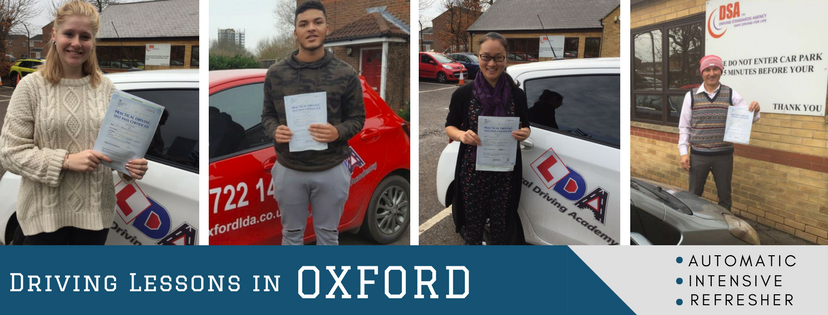
    On your very first driving lesson with Oxford Learning Driving Academy (LDA) your instructor is going to go through with you exactly what it takes to be a safe driver and how to pass your test at the first time of trying. Then on each and every lesson you will use our simple formula, then soon not only will you be a safe driver able of passing your test but you will be able to detect any faults you might find.

    When a learner driver starts to think about passing their driving test, there is a massive element of enjoyment and adventure for you, but you will also have some serious questions to ask. You don’t want to be ripped off, you want a really nice driving instructor in Abingdon who you can get on with, and you want the best opportunity of passing your driving test first time.

    The problem you have is that there are so many driving schools in Abingdon who are you going to choose from? They all look the same – right? And there is hardly any info out there to help you decipher who is going to give you the best driving lessons in Abingdon, but today we have you ll sorted.

    In short, the way we are going to teach you will make you feel comfortable, relaxed, in control and with the knowledge you can really impress the driving examiner.

    Automatic driving lessons in Abingdon – An Easier Way

    Have you noticed just how super cool automatic cars have become, they are not just money savers because you pay zero road tax and very little fuel on the electric versions but just take a look at cars like the Tesla. Just totally amazing and totally automatic.

    Taking automatic driving lessons in Abingdon is a wise thing to do, it’s less hassle, fewer lessons needed, and driving an auto is just so easy. Give us a call now on 01865 722 148 or send a message via the Contact Form online and schedule your driving lessons in under a minute.

    Service Areas Oxfordshire:

    Abingdon , Oxford, Banbury, Bicester, Didcot, Kidlington, Thame, Wallingford, Wantage , Watlington, Witney, Woodstock

  • Wantage Driving Lessons – Driving School

    Wantage Driving Lessons – Driving School

    Driving Lessons, Instructor Wantage – Automatic and Manual

    You know, learning to drive is an amazing feeling and it’s not just the exhilaration of passing your driving test that totally blows you away, but right from your very first driving lessons in Wantage you are going to be feeling so good. Call now on 01865 722 148 or send a message via the Contact Form online and schedule in your driving lessons today!
    Many learner drivers are would love to have the opportunity of being able to get their driving licence just by sitting on driving test, it’s not just about saving money but no one likes to go through the stressful situation of a driving test so we are going to give you the best guidelines.

    Even before you pick up the phone and give us a call we are going to share with you some top tips right now on how to amaze (yes we did say amaze) the driving examiner.

    What you need to do is to fully understand what the examiner is trying to observe, and that are:

    1. To see you in total control of the car at all times.
    2. To observe you are following the Highway Code.
    3. That you have the ability to spot and avoid hazards.
    4. And crucially you have the desire to want to be a safe driverSo wouldn’t it make perfect sense to use those 4 steps right from your very first driving lesson? And it is the real reason why we are great at making people very safe drivers who are more than capable of passing their test at the first attempt.

    Automatic driving lessons in Wantage – A Short Cut To Your Driving Licence in Oxfordshire

    A few years ago people didn’t like passing their driving test in an automatic car, it really had a bad stigma, as if you didn’t have the capability of driving. But in today’s world that has changed totally and taking automatic driving lessons in Wantage is very popular.

    Automatic driving schools in Wantage are pretty hard to come by but more and more people want to learn in an auto because it’s so easy, no gears, no rolling back on hill starts and all the cool cars are becoming electric, just look at Tesla. Everyone would love a Tesla car, cheap to run, easy to drive as it’s an automatic and great to look at.

    If you want to get on the road stress and hassle free, call us and ask about our availability of automatic driving instructors in Wantage.

  • Government Fines for Mobile Phone Use When Driving

    Government Fines for Mobile Phone Use When Driving

    Using mobile phones when driving

    It’s illegal to use your phone while driving or riding a motorcycle unless you have hands-free access, such as:

    • a bluetooth headset
    • voice command
    • a dashboard holder

    The law still applies to you if you’re:

    • stopped at traffic lights
    • queuing in traffic
    • supervising a learner driver

    Hands-free

    If you use your phone hands-free, you must stay in full control of your vehicle at all times.

    The police can stop you if they think you’re not in control because you’re distracted and you can be prosecuted.

    When you can use a hand-held phone

    You can use a hand-held phone if either of these apply:

    • you’re safely parked
    • you need to call 999 or 112 in an emergency and it’s unsafe or impractical to stop

    Penalties

    You can get 6 penalty points and a £200 fine if you use a hand-held phone.

    You can also be taken to court where you can:

    • be banned from driving or riding
    • get a maximum fine of £1,000 (£2,500 if you’re driving a lorry or bus)

    If you passed your driving test in the last 2 years, you’ll lose your licence.

    Read the full article on the Gov.Co.Uk website

    Call now to book your driving lessons on 01865 722 148 or use the Contact Form to send a message or even book online.

  • Inform the DVLA of your medical condition

    Inform the DVLA of your medical condition

    Report certain types of medical conditions to DVLA if you’re a car driver or motorcyclist.

    The DVLA must be notified for certain health conditions including:

    • Ataxia
    • essential tremor
    • Friedrich’s ataxia
    • Guillain Barré syndrome
    • Huntington’s disease
    • motor neurone disease
    • multiple sclerosis
    • myasthenia gravis

    What happens after you tell DVLA

    You’ll usually get a decision within 6 weeks. You’ll get a letter from DVLA if it’s going to take longer.

    DVLA might:

    • contact your doctor or consultant
    • arrange for you to be examined
    • ask you to take a driving assessment, or an eyesight or driving test

    You can usually keep driving while DVLA are considering your application.

    If you’ve told DVLA about a condition when applying to renew your licence, follow the guidance about driving that’s in the form.

    Other conditions that should be reported are listed below in alphabetical order:

    A

    Absence seizures
    Acoustic neuroma
    Addison’s disease
    Agoraphobia
    AIDS
    Alcohol problems
    Alzheimer’s disease
    Amyotrophic Lateral Sclerosis
    Amputations
    Angina
    Angioma
    Angioplasty
    Ankylosing spondylitis
    Anorexia nervosa
    Anxiety
    Aortic aneurysm
    Arachnoid cyst
    Arnold-Chiari malformation
    Arrhythmia
    Atrial defibrillator
    Arteriovenous malformation
    Arthritis
    Asperger syndrome
    Ataxia
    Attention deficit/hyperactivity disorder (ADHD)
    Autistic spectrum disorders (ASD)

    B

    Balloon angioplasty (leg)
    Bipolar disorder
    Blackouts
    Blepharospasm
    Blood clots
    Blood pressure
    Brachial plexus injury
    Brain abscess, cyst or encephalitis
    Brain aneurysm
    Brain angioma
    Brain haemorrhage
    Brain injury (traumatic)
    Brain tumours
    Branch retinal vein occlusion
    Broken limbs and driving
    Burr hole surgery

    C

    Caesarean section
    Cancer
    Cataracts
    Catheter ablation
    Cardiac problems
    Carotid artery stenosis
    Cataplexy
    Cerebral palsy
    Chronic aortic dissection
    Cognitive problems
    Congenital heart disease
    Convulsions
    Coronary artery bypass or disease
    Coronary angioplasty
    Cystic fibrosis

    D

    Deafness
    Defibrillator
    Déjà vu
    Dementia
    Depression
    Diabetes
    Diabetic retinopathy
    Dilated cardiomyopathy
    Diplopia (double vision)
    Dizziness
    Drug misuse

    E

    Eating disorders
    Empyema (brain)
    Epilepsy
    Essential tremor

    F

    Fainting
    Fits
    Fractured skull
    Friedreich’s ataxia

    G

    Giddiness (recurring)
    Glaucoma
    Global amnesia
    Grand mal seizures
    Guillain-Barré syndrome

    H

    Head injury
    Heart attack
    Heart arrhythmia
    Heart failure
    Heart murmurs
    Heart palpitations
    Heart valve disease or replacement valve
    Hemianopia
    High blood pressure
    HIV
    Hodgkin’s lymphoma
    Huntington’s disease
    Hydrocephalus
    Hypertension
    Hypertrophic cardiomyopathy
    Hypoglycaemia
    Hypoxic brain damage
    Hysterectomy

    I

    Implantable cardioverter defibrillator (ICD)
    Intracerebral haemorrhage
    Ischaemic heart disease

    K

    Kidney dialysis
    Kidney problems
    Korsakoff’s syndrome

    L

    Labyrinthitis
    Learning difficulties
    Left bundle branch block
    Leukaemia
    Lewy body dementia
    Limb disability
    Low blood sugar
    Lumboperitoneal shunt
    Lung cancer
    Lymphoma

    M

    Macular degeneration
    Malignant brain tumours
    Malignant melanoma
    Manic depressive psychosis
    Marfan syndrome
    Medulloblastoma
    Memory problems (severe)
    Meningioma
    Mini-stroke
    Monocular vision
    Motor neurone disease
    Multiple sclerosis
    Myasthenia gravis
    Myocardial infarction
    Myoclonus

    N

    Narcolepsy
    Night blindness
    Nystagmus

    O

    Obsessive compulsive disorder
    Obstructive sleep apnoea
    Optic atrophy
    Optic neuritis

    P

    Pacemakers
    Palpitations
    Paranoia
    Paranoid schizophrenia
    Paraplegia
    Parkinson’s disease
    Peripheral arterial disease
    Peripheral neuropathy
    Personality disorder
    Petit mal seizures
    Pituitary tumour
    Post traumatic stress disorder (PTSD)
    Psychosis
    Psychotic depression

    R

    Renal dialysis
    Retinal treatment
    Retinopathy

    S

    Schizo-affective disorder
    Schizophrenia
    Scotoma
    Seizures
    Sight in one eye only
    Sleep apnoea
    Sleepiness (excessive daytime)
    Spinal problems and injuries and driving
    Stroke
    Subarachnoid haemorrhage
    Surgery
    Syncope

    T

    Tachycardia
    Temporal lobe epilepsy
    Tonic clonic fits
    Tourette’s syndrome
    Transient global amnesia
    Transient ischaemic attack (TIA)
    Tunnel vision

    U

    Usher syndrome
    V

    Valve disease or replacement valve
    Ventricular defibrillator
    Vertigo
    Vision in one eye only
    Visual acuity (reduced)
    Visual field defects
    VP shunts

    W

    Wolff-Parkinson-White syndrome

  • Free MOT reminders from the DVSA

    Free MOT reminders from the DVSA

    Get Free MOT reminders

    You can be fined up to £1,000 for driving a vehicle without a valid MOT.

    Sign up to get free reminders by text message or email when your MOT is due.

    You’ll get a reminder one month before your MOT is due. You’ll get another reminder if you still haven’t had your vehicle tested 2 weeks before your MOT is due

    Start now

    Before you start

    You need:

    • the vehicle’s number plate (registration number)
    • a mobile phone number or email address

    Stop getting reminders

    You have to unsubscribe to stop getting reminders for a vehicle you’ve:

    • sold
    • transferred to someone else
    • scrapped or written-off
    • registered as off the road

    Unsubscribe by:

    • following the instructions in the text message
    • clicking the unsubscribe link in the email you’ve been sent

    You’ll pay the cost of a standard text message to unsubscribe from text reminders.

    Help with reminders

    Contact the Driver and Vehicle Standards Agency (DVSA) to get help with MOT reminders.

    DVSA customer service centre
    Telephone: 0300 123 9000
    Monday to Friday, 7:30am to 6pm

  • New Driving Test – Getting Ready

    New Driving Test – Getting Ready

    New Driving Test December 2025

    Driving tests… they’ve long been feared and left learners frustrated. Now, change is around the corner – as of December 2025 the age-old test will shake-up what is expected of learners. Here we take a look at what you need to know about the upcoming driving test changes – and if you want a visual run-through of what to expect, watch the DVLA YouTube video on the new driving test changes.

    First things first – why is the new test being introduced?

    In short, the new test has been designed by the DVLA to make drivers safer on the roads and to ensure that the new test takes account of modern driving. Read more on DVSA website here.

    Here’s the official word on the ‘why’ behind the change as outlined on their website:

    “The changes are designed to make sure new drivers have the skills they’ll need to help them through a lifetime of safe driving”.

    The 4 core changes… As explained by The Local Driving Academy, your local driving school in Oxford

    1. You’ll need to drive independently for 20 minutes (up from the current time of 10 minutes)

    The independent element of the exam currently lasts for around 10 minutes. From December this will be doubled to 20 minutes – accounting for around half of the test.

    2. You’ll have to follow directions from a sat nav

    During the independent driving element of your exam you’ll most likely be asked to follow the sat nav (which will be a TomTom Start 52). Your examiner will set the route, however you can ask them about the end destination if you’re unsure. You should note that it doesn’t matter if you go the wrong way unless you make a driving fault whilst doing so. One in 5 tests will involve the following of traffic signs, instead of a sat nav.

    3. You’ll face new reversing manoeuvres

    Previously learners needed to ‘reverse around a corner’ or ‘turn-in-the-road’ (also known as a 3 point turn). Instead you’ll be asked to complete one of the following three reversing manoeuvres…
    • Parallel park on the side of the road
    • Park in a bay – either driving forwards in and reversing backwards out, or reversing backwards in and driving forwards out (your examiner will instruct you as to which you should do)
    • Pull up to the right-hand side of the road, reverse backwards 2 car lengths then re-join the traffic

    4. You’ll need to answer 2 vehicle safety questions – one before the test and one while driving

    You’re going to be asked both:
    • A ‘Tell Me’ question – explaining how you’d carry out a specified safety task prior to setting off.
    • A ‘Show Me’ question – explaining how you’d carry out a specified safety task whilst driving.

    Book Driving lessons in Oxford

    Get into gear… there are just 3 months until the test changes. Call now on 01865 722 148 or send a message via the Contact Form online and schedule in your driving lessons today!
    The new test will come into play as of December 4th 2025.

    We offer driving lessons in Didcot, Bicester, Abingdon, Wantage and all towns and villages in Oxfordshire

    If you’re already taking driving lessons in Oxford and have booked your test before the changes, your driving instructor should have talked

  • Vacancy – Driving Instructor Oxford

    Vacancy – Driving Instructor Oxford

    Get On The Road To A New Career With LDA Instructor Training UK

    In a 2022 survey, a third of UK employees said that they were unhappy in their jobs, with many expressing a desire to escape the daily grind and work for themselves. A career as a driving instructor allows you to earn a competitive salary while setting your own hours to fit in with responsibilities such as childcare – or simply more time for the things that you enjoy doing.

    What is driving instructor training in the UK?

    Working as a driving instructor involves a lot of responsibility and, as such, you will need professional training in order to pass three ADI core assessments. You will also need to have held a full clean driving license for at least three years and be over the age of 21. It should go without saying that you’ll also need to be good with people as you’ll be teaching a wide range of students from teens to pensioners.

    Why train with LDA, Oxford UK?

    Founded in 2010, we’re proud to be able to put more safe drivers on Oxfordshire’s roads than any other instructor academy. We offer comprehensive instructor training at extremely competitive prices to put you behind the wheel of your new career as quickly as possible. Our training package includes:
    ● Full support throughout the three ADI modules as well as feedback
    ● Free use of practice vehicles
    ● Access to our PDI buddy system

    ● Additional support from renowned trainers in the industry either online or by Zoom Unlike other instructor academies, our support doesn’t stop at getting you through your ADI tests. After passing the first two modules and 40 hours of training, you’ll be eligible to apply for a pink badge which will allow you to provide lessons ahead of full qualification (green badge). Once you’re in possession of your pink badge, we’ll continue to support you during your work with students – and our support continues until after you’ve gained your green badge.

    Starting your driver training journey in the UK

    Starting a new career can be daunting and you’ll no doubt have lots of questions. Our support team is on hand to walk you through the process of becoming a driving instructor and answer any questions you may have so, take the brakes off your career and get in touch today.

    How to Become Driving Instructor / Driving Instructor Requirement UK

    How to become a driving instructor in the UK process explained. Plus what are the benefits of becoming a driving instructor?
    https://www.youtube.com/watch?v=b8mgx38PCRs

    About Founder of LDA, Oxford UK

    Hi, I’m Sayed Sadaat, the founder and manager of LDA, the leading provider of driving instructor training in the UK. I have been an Approved Driving Instructor (ADI) for over 15 years and I’m passionate about helping people become safe and confident drivers.

    I started LDA in Oxford in 2010, with a vision to offer high-quality and affordable driving lessons to learners of all ages and abilities. Since then, I have grown the company into one of the most successful driving academies in Oxfordshire, with a team of driving experts who share my enthusiasm and dedication.

    As well as teaching learners, I also specialise in training for driving instructors. I believe that comprehensive and forward-thinking training is the key to producing great instructors who can pass on their skills and knowledge to the next generation of drivers. That’s why I have developed a multi award winning driving instructor training programme that covers all aspects of the job, from theory and practical tests to business and marketing skills.

    Becoming a driving instructor is a great way of becoming your own boss and enjoying a flexible and rewarding career. You can set your own hours, choose your own clients, and earn a good income while making a positive difference in people’s lives. Whether you want to start from scratch or upgrade your existing qualifications, I can help you achieve your goals and become a Grade A instructor.

    I’m not only a driving instructor, but also a lifelong learner. I hold a certification in NLP (Neuro-Linguistic Programming), which helps me communicate effectively and tailor my teaching methods to suit different learning styles. I’m also currently studying Politics and International Relations at Oxford Ruskin College, as I’m interested in the world around me and how it affects us.

    When I’m not working or studying, I like to relax by watching football, reading books, travelling to new places, and socialising with friends and family.

    If you are looking for a friendly and professional driving instructor trainer in Oxfordshire who can help you achieve your dream of becoming a driving instructor, look no further than LDA. I’ll be with you every step of the way on this exciting journey. Contact me today and let’s get started!

    Kev Field – Oxford, UK

    There are 41.3 million registered vehicles in the UK today and so producing safe drivers is more important than ever before. Driving has always been my passion and, during my career, I’ve been behind the wheel of everything from a forklift truck to an articulated lorry, having gained my HGV license at the tender age of 21. My passion for driving led me to devote my career to driving instructor training in the UK.

    My love of driving and passion for helping others to become safe and confident drivers led me to train with the Coaching Academy and, in my capacity as a Personal Development & Business Coach, I’m able to combine my qualifications as an instructor and ADI trainer with the tools needed to help others improve their driving confidence. Even after passing their test, many people suffer a lack of confidence when driving – for example; 1 in 7 motorists say that they are nervous about driving on motorways. I’m proud to be able to help clients overcome their fears and become super-confident drivers.

    Great drivers do, of course, begin with great instructors and I’m committed to delivering the best possible learning experience for LDA’s driving instructor trainees. As well as being a registered Grade A ORDIT instructor, I’m a Driver Metrics trainer and one of only a handful of people to have delivered the BTEC4 on behalf of the Tri-coaching Partnership.

    If you’re ready to train to be a driving instructor, what are you waiting for? LDA’s driving instructor courses in Oxfordshire offer flexible payment plans as well as lessons to fit in with your other responsibilities such as work and childcare

    Khalid Aziz – Oxford, UK

    I became an ADI (Approved Driving Instructor) for LDA in 2016 and it was the best decision I ever made; in fact, I only wish I’d started my ADI journey sooner. As an ADI, I’ve been able to reset my work / life balance as the flexibility of the role allows me to choose my own working hours – which means more time for family and never missing those important appointments, school events and holidays. Having been born and raised in Oxford, LDA was the obvious choice for me and I’m proud to be part of such a supportive driving instructor training centre in my local area.

    If you’re worried about the cost of becoming a driving instructor, LDA offers some great payment options and the driving instructor training is so flexible that you can even work it around your current job.

    There’s plenty of information on the LDA website for you to peruse but, if you want the lowdown on what it’s like to become a PDI / ADI, don’t hesitate to get in touch and I’ll be happy to guide you through the process.


  • 6 New Driving Laws in 2018

    6 New Driving Laws in 2018

    6 New Driving Laws in 2018

    Motoring law changes all the time, but in 2018 there are some pretty big changes afoot. Here are six new changes to the law that will affect each and every one of us, so read up to ensure you stay on the right side of the rules as published on the Car Keys website.

    For free advice just ask on on 01865 722 148 or send a message via the Contact Form.

    New MoT legislation

    There are new MoT changes that come into force on May 20th, which introduce new testable items.

    From this date, any diesel car that has had its DPF removed or tampered with will instantly fail the test, while aftermarket high definition headlamp bulbs will also be outlawed.

    Reversing lights will be tested for the first time, and your car will also fail if the brake fluid is visually deteriorated.

    Classic cars over 40 years old will now be exempt from testing, too.

    Finally, the current system of advisories will be replaced with minor, major and dangerous faults. Minor faults will work the same as the current advisory system and won’t constitute a fail. A car with dangerous faults cannot be driven away from the test until the repairs have been carried out.

    Here’s all you need to know about MOT tests and pre checks

    Learner drivers to be allowed on motorways

    Starting this year, learners will be allowed on motorways for the first time, though motorway driving won’t form part of the test as there are some regions of the country where this will be impractical, such as Western Wales and the Scottish Highlands.

    All instructors will be encouraged to give drivers some motorway training, you can read more on the Pass Plus page here.

    Penalties for misusing motorways

    New ANPR-based (Automatic Number Plate Recognition) cameras will be introduced on major motorways to monitor misuse of the hard shoulder. If a driver uses the hard shoulder on a managed motorway when it isn’t open, or drives in a lane with a red ‘X’ above it, the cameras will automatically trigger a penalty, which includes a £100 fine and three points on your driving licence. Keep an eye on those gantry signs to avoid an unpleasant surprise…

    Changes to the driving test

    As well as the independent driving element of the current test, where the examiner gives no instructions for 10 minutes, the new test laws will include a section where delegates are expected to follow instructions from a sat nav unit to prove they can follow the directions safely.

    The test will also include a section where the driver is asked to demonstrate a function of the car, such as how the windscreen wipers work, or how to demist the windscreen.

    Reversing into a car park bay is now also part of the test.

    Tax rises for diesel cars

    First year car tax for all diesel cars that aren’t compliant with the Euro 6 emissions standard will rise by one tax bracket from April 1st, with rates to increase by anything from £20 to £560 in the first year depending on the model and its current emissions.

    Unsurprisingly, the government hasn’t publicised this one very much!

    Children’s car seats

    Rules around child car seat safety have changes significantly.

    New models of backless booster seats will only be suitable for children taller than 125cm or weighing more than 22kg, with high back seats featuring guides to lower the level of the seatbelt in line with the passenger’s shoulders.

    In addition, all children below 15 months old must now travel in a backwards-facing car seat.

    All children must use a child car seat until they’re 12 years old or 135 centimetres tall, whichever comes first. Children over 12 or more than 135cm tall must wear a seatbelt. You can choose a child car seat based on your child’s height or weight.

  • Five things you don’t find in cars anymore

    Five things you don’t find in cars anymore

    Retro Car Trends That Used To Be Popular

    Things that were once luxuries are now taken for granted. Power steering, electric windows, central locking – a few years back, it’d be a rare to find these on even the most opulent of cars. Of course, things are very different today – new superminis get more tech than the luxury saloons of the 90s.

    To remind ourselves how far car design has moved on, we’ve taken a trip down memory lane and had a look at some must-have options and accessories of days gone by. We’re not sure any deserve a renaissance, but they are testament to how far design and technology (not to mention taste) has developed.

    Pop-up headlights

    Once upon a time, you can imagine some automotive designer demoing this to a room full of executive decision-makers and the chairman exalting “Oh my god, it’s the future!”

    Sadly, despite adding an oddly human touch to cars thanks to the headlights opening and shutting like sleepy eye-lids, it wasn’t.

    Designed to give cars a sleeker profile, hidden headlights allowed manufacturers to produce low-down sports cars while getting around headlight height requirements.

    While designers may have got around safety requirements once, in the last decade new regulations have pushed it out of favour – European design laws now require the front-end of cars to be more readily deformable to protect pedestrians in an accident.

    As it is difficult and costly to create hidden headlights that comply with these laws, we’ve had to say goodbye to winking sports cars.

    Removable stereos

    The infotainment systems in modern cars are, in effect, part of the car itself. Not too long ago however, things were different. All stereos came in one universal shape and, thanks to the questionable car security at the time, they became a top target for thieves.

    The answer came in the form of a removable fascia. Designed to deter shady characters, anyone who managed to prise the radio out would find it useless without its front fascia.

    A simple and effective feature it may have been, there’s no question that modern touchscreen tech, and car security for that matter, is infinitely superior.

    Sun strips

    This must-have accessory of the disco era graced the windscreen tops of many would-be rally drivers and, while sun visors probably weren’t what they are today, shading your eyes from the rays came at the expense of obscuring a good portion of your windscreen.

    For those that really wanted to stand out, decking out your sun strip with slogans, or your loved one’s name, became the thing to do.

    We can’t really understand the reason for this, but it’s probably good that this trend was consigned to the history books.

    Beaded seat covers

    beaded seat covers

    Pensioners and minicab drivers – the only two demographics whose interiors are still likely donning beaded seat covers. But how did they ever catch on in the first place?

    It was once reported that they relieved backache. That said, you don’t see any hanging up in the pharmacists, so we can only presume painkillers for back complaints have progressed substantially since the late ‘80s.

    We’re not sure how hundreds of knobbly wooden balls pushing into your back can be comfortable, but one positive is that it did keep you cool on hot days, especially if your car was adorned with velour upholstery.

    And finally vinyl roofs

    Sticking with fabrics, it was more common to see vinyl on the outside of the car than on the inside in the 1970s. Available on only the plushest trim levels, if your car had a vinyl roof, people knew you were doing well for yourself.

    The idea of a fabric-covered roof on a hardtop may seem ridiculous now but the idea stems from the early days of motoring.

    When the automotive world was in its primitive stages, easing the transition from horse and carriage to motor vehicle was a key consideration and manufacturers actually tried to make their vehicles resemble a carriage.

    So, if you ever see a 1973 Ford Cortina and are pondering the reason behind its squidgy brown roof, it’s all down to horses.